English:
http://tintinadventures.tripod.com/id11.html
Mostrando las entradas con la etiqueta comics. Mostrar todas las entradas
Mostrando las entradas con la etiqueta comics. Mostrar todas las entradas
jueves, 23 de agosto de 2012


lunes, 25 de julio de 2011
Trucutú - Brucutu
Alley Ooop is a syndicated comic strip, created in 1932 by American cartoonist V. T. Hamlin, who wrote and drew the popular and influential strip through four decades for Newspaper Enterprise Association. Hamlin introduced an engaging cast of characters, and his storylines entertained with a combination of adventure, fantasy and humor.
Alley Oop, the strip's title character, was a sturdy citizen in the prehistoric kingdom of Moo. He rode his pet dinosaur, Dinny, carried a stone war hammer and wore nothing but a fur loincloth. He would rather fight dinosaurs in the jungle than deal with his fellow countrymen in Moo's capital (and only) cave-town. In spite of these exotic settings, the stories were often satires of American suburban life.
Alley Oop's name derived from the "let's go" phrase allez, hop!, used as a cue by French gymnasts and trapeze artists. Initially, Alley Oop was a daily strip which had a run from December 5, 1932 to April 26, 1933. Beginning August 7, 1933, the strip was distributed by NEA syndicate, and the early material was reworked for a larger readership. The strip added a full page Sunday strip, on September 9, 1934. It also appeared in half page, tabloid and half tab formats, which were smaller and/or dropped panels. During World War II, the full page vanished, and newspapers were offered a third of a page version that dropped panels, so more strips could fit on a page.
martes, 25 de enero de 2011

miércoles, 7 de octubre de 2009
Isidoro Cañones, solterón empedernido
Fuente
Isidoro era un fiel representante del típico "chanta porteño", y recreaba el prototipo del hombre de la noche. Sus andanzas fascinaban aún a aquellos que no comulgaban con su ética y sus métodos, y lograba que muchos anhelaran vivir la vida como él, una vida que, en sus comienzos, representaba a todo un sector del país, que, sin ser de la elite económica, vivía y conocía el Buenos Aires nocturno, y disfrutaba de las fiestas de la alta sociedad.
Isidoro era un fiel representante del típico "chanta porteño", y recreaba el prototipo del hombre de la noche. Sus andanzas fascinaban aún a aquellos que no comulgaban con su ética y sus métodos, y lograba que muchos anhelaran vivir la vida como él, una vida que, en sus comienzos, representaba a todo un sector del país, que, sin ser de la elite económica, vivía y conocía el Buenos Aires nocturno, y disfrutaba de las fiestas de la alta sociedad.
| Para quienes no accedían a las “Boites” y al “Jet-set”, Isidoro era una forma de vivir y conocer a Buenos Aires de noche. Incluso, todavía, en los años '40, era necesario vestir esmoquin y moñito para entrar en las fiestas de la alta sociedad (a propósito del tema, el apellido “Cañones” Isidoro sólo lo usaba como aquella dote que le permitía acceder a ciertos lugares paquetes y presentarse en sociedad). | 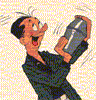 |
|
| ¿Cómo definirlo? Según el escritor Luis Guzmán, “Isidoro era un playboy de otro tiempo y hacía gala de un cinismo casi inocente; era un tarambana, y a su vez un antihéroe algo querible a partir de sus fracasos, nunca demasiado malo ni demasiado cínico como para juzgarlo”. Por su parte, el filósofo Omar Bello dijo que “nadie sintetizó mejor al porteño y, por añadidura, al argentino promedio: un chanta irresponsable, pero increíblemente carismático. Ladrón, pero sin sangre ni violencia. Estafador del ingenio". Andrés Accorsi expresó, entre otras cosas, que "Isidoro no estaba del lado de los buenos: estaba del lado de Isidoro. Si descubría las fallas del sistema, era en su propio beneficio y no para cambiar una situación injusta. La suya era una revolución frívola, que bien justificaba las infames estafas de las que se valía con tal de obtener guita, chapa y chicas". Es importante señalar también, por supuesto, lo que dijo una vez, acerca del personaje, el semiólogo Oscar Steinberg: "Isidoro tenía el optimismo del pequeño triunfador cotidiano, a quien le importa lo que pasa hoy y no mañana". |
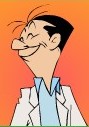
| La valentía, como se dijo, no era su fuerte, y, aunque Isidoro Cañones era tramposo y algo indolente, en el fondo era de buen corazón, lo que lo hacía querible. Isidoro era aficionado a la vida fácil, a las carreras de caballos, a los autos deportivos descapotables (en general, el modelo de auto que utilizaba Isidoro era un BMW Cabriolet 503), y a su inseparable "Scotch", que lo acompañaba diariamente. Generalmente con polera negra, saco cruzado (de anchas solapas), mocasines relucientes, pelo a la gomina (aunque con algunos pelos eternamente parados), y un vaso de whisky “Chivas Regal” para entonarse, Isidoro iba de fiesta en fiesta buscando diversión y viviendo la vida a su manera, ya que saldría a festejar cualquier asunto que sería de su agrado. También podía pasar jornadas enteras jugando al póquer (ver tira). Otra cosa que le gustaba era bailar, sobre todo con música jóven y popular (click aquí), aunque dominaba distintos ritmos. | 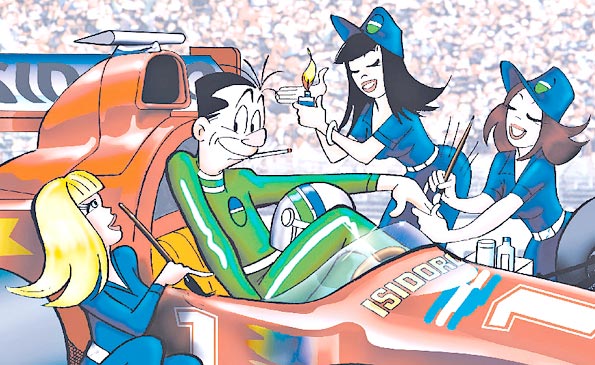 |
| |
|
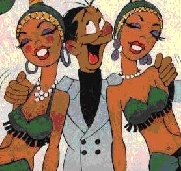
| Isidoro era capaz de dar una respuesta ingeniosa para impresionar a la barra de amigos o seducir a una mujer. Era el galán atrevido y el trasnochador que le huía al trabajo (nunca se le había conocido alguno fijo). Es más, para él, trabajar era casi denigrante. Se pasaba el día tratando de inventar negocios fantásticos y pensando a quién embaucar. A esa ocupación, se le sumaba el Isidoro conquistador. Sus conquistas permitían ir agregando personajes a la trama. Los amores de Isidoro, mujeres rubias, con dinero, y preferentemente de doble apellido, eran lo que entonces se denominaba “la crema de Buenos Aires”. Como dijo una vez Fontanarrosa: "Isidoro no alcanzaba a ser un 'dandy' sino más bien un solterón empedernido". | 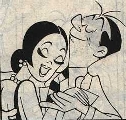 |
sábado, 26 de septiembre de 2009
Repetitive Strain Injury

Fokke & Sukke suffer from RSI:
"According to the doctor there is only one cure..."
"... a girlfriend!"
Historia de las historietas holandesas
The History of Dutch Comics
Welcome to the illustrated History of Dutch Comics, an overview and introduction to comics and 'strips' in the Netherlands.
Dutch as language
Dutch comic artists in the Comiclopedia
Welcome to the illustrated History of Dutch Comics, an overview and introduction to comics and 'strips' in the Netherlands.
Dutch as language
 | Origins of early Dutch comics - Early examples of sequential art from the Dutch 'low lands' date back to the Middle Ages, and gained more importance right on through the 1800s. |
 | Dutch comics 1920-1940 - In the interbellum period between the World Wars, Holland discovered imported comics, and achieved a rich comics productivity itself. |
 | Dutch comics around 1940-1945 - Because of German occupation in World War II, Holland had to deal with a ban on imports, the rise of propaganda in comics, and scarcity of paper. |
 | Dutch comics 1945-1950 - After the war, the initial paper scarcity and a ban on the small beeldromans made an impact, but soon Dutch comics were off to a new start. |
 | Dutch comics 1950-1967 - With an increasing number of newspapers, the comics industry bloomed again. The import of American comics also made its mark on the Dutch scene. |
 | Dutch comics 1968-1980 - Not surprisingly, 1968 was a revolutionary year for comics, and many Dutch underground comix magazines flourished throughout the seventies. |
 | Dutch comics around 1980 - Inspired by international comics, Dutch comic artists reached a new level of professionality. |
 | Contemporary Dutch comics - A new generation of comic artists has emerged in Holland during the last decade. |
martes, 17 de marzo de 2009
Domino mask

A domino mask is a small, rounded mask covering only the eyes and the space between them. Since the 18th century, the domino mask is worn during carnival, especially in Venice, where its origin lies. In comic book and popular culture, a domino mask indicates that a superhero/heroine wishes to maintain his/her secret identity; at the same time the mask actually obscures little of the facial features that make the character recognizable. For example, Batman's sidekick Robin and the Lone Ranger wear a domino mask. A domino mask is very similar to a masquerade mask, except it is not as embellished or decorated.
The original designs for Batman utilised a simple domino mask as part of his disguise, but Batman co-creator Bill Finger suggested that Bob Kane give him a cape and cowl instead.
Lady Luck
Lady Luck is a fictional, American comic-strip crime fighter and adventuress created and designed in 1940 by Will Eisner (who wrote the first two Lady Luck stories under the pseudonym "Ford Davis"), with artist Chuck Mazoujian. Writer Dick French then took over scripting.[2] Through 1946, she starred in a namesake, four-page weekly feature published in a Sunday-newspaper comic-book insert colloquially called "The Spirit Section". This 16-page, tabloid-sized, newsprint comic book, sold as part of eventually 20 Sunday newspapers with a combined circulation of as many as five million, starred Eisner's masked detective The Spirit and also initially included the feature Mr. Mystic, plus filler materia
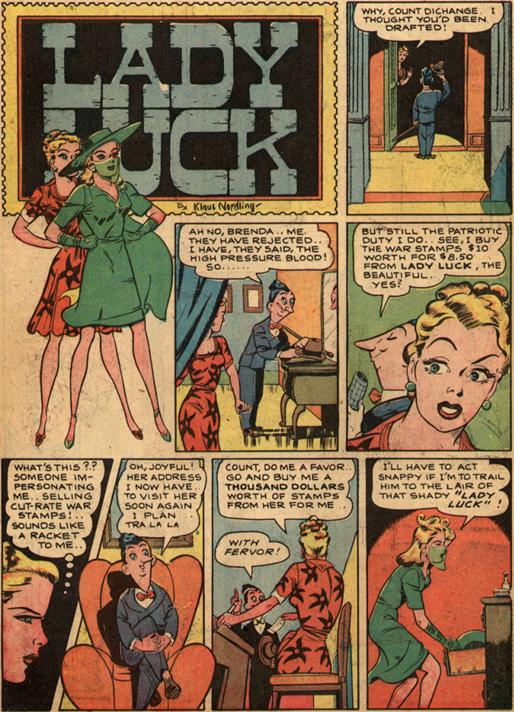 more (to read the strip)...
The Spirit
 The Spirit (Denny Colt) is a fictional character appearing in the comic books published by DC Comics. Created by writer-artist Will Eisner, he first appeared in Spirit Section #1 (June 1940).
A crime-fighter, the Spirit debuted on June 2, 1940, in a seven-page insert into American Sunday-newspaper comics sections.
The Spirit chronicles the adventures of a masked vigilante who fights crime with the blessing of the city's police commissioner Dolan, an old friend. Despite the Spirit's origin as a detective named Denny Colt, his real identity was virtually unmentioned again and for all intents and purposes he was simply "the Spirit". The stories range through a wide variety of styles, from straightforward crime drama and noir to lighthearted adventure, from mystery and horror to comedy and love stories, often with hybrid elements that twisted genre and expectations.
[Deutscher Blog über das Thema]
"Tengo el aspecto de una chica buena?"(hacer doble click en la foto para ver el trailer)

Download of the ripped film
(use torrent manager software utorrent)
Plot of the film
In Central City, rookie cop Denny Colt returns from the dead as the detective known only as the Spirit to fight crime. After he finds his nemesis, the Octopus, at the Central City mud flats, the femme fatale Sand Saref discovers two chests in a nearby pond. She tries to flee with both chests, but the Octopus shoots at her, snapping the line that connects the two chests together. After a fight with the Spirit, Octopus takes the remaining chest that Saref left behind and escapes with one of his thugs. The Octopus wants the mystical Blood of Heracles in order to become immortal and Sand Saref wants the treasure of the Argonauts, but both people end up with the wrong chest, Sand with the blood and the Octopus with the treasure of the Argonauts.
(use torrent manager software utorrent)
Plot of the film
In Central City, rookie cop Denny Colt returns from the dead as the detective known only as the Spirit to fight crime. After he finds his nemesis, the Octopus, at the Central City mud flats, the femme fatale Sand Saref discovers two chests in a nearby pond. She tries to flee with both chests, but the Octopus shoots at her, snapping the line that connects the two chests together. After a fight with the Spirit, Octopus takes the remaining chest that Saref left behind and escapes with one of his thugs. The Octopus wants the mystical Blood of Heracles in order to become immortal and Sand Saref wants the treasure of the Argonauts, but both people end up with the wrong chest, Sand with the blood and the Octopus with the treasure of the Argonauts.
miércoles, 11 de marzo de 2009
Calvin and Hobbes
Calvin and Hobbes
Calvin and Hobbes is a comic strip written and illustrated by Bill Watterson, following the humorous antics of Calvin, an imaginative six-year old boy, and Hobbes, his energetic and sardonic—albeit stuffed—tiger. The pair are named after John Calvin, a 16th-century French Reformation theologian, and Thomas Hobbes, a 17th-century English political philosopher.[1] The strip was syndicated daily from November 18, 1985 to December 31, 1995. At its height, Calvin and Hobbes was featured in over 2,400 newspapers worldwide. To date, more than 30 million copies of the 18 Calvin and Hobbes books have been printed.
Calvin's alter egos
all C&H Strips
Calvin and Hobbes is a comic strip written and illustrated by Bill Watterson, following the humorous antics of Calvin, an imaginative six-year old boy, and Hobbes, his energetic and sardonic—albeit stuffed—tiger. The pair are named after John Calvin, a 16th-century French Reformation theologian, and Thomas Hobbes, a 17th-century English political philosopher.[1] The strip was syndicated daily from November 18, 1985 to December 31, 1995. At its height, Calvin and Hobbes was featured in over 2,400 newspapers worldwide. To date, more than 30 million copies of the 18 Calvin and Hobbes books have been printed.
Calvin's alter egos
all C&H Strips
| Academia, Here I Come! Bill Watterson - Calvin and Hobbes [The cartoon artwork reproduced hereafter is Copyright © 2005 Bill Watterson, all rights reserved. It was originally published in Stanford Daily and online at: http://www.gocomics.com/calvinandhobbes/. This version for class use only; no reproduction or printing allowed.]  | ||
lunes, 9 de marzo de 2009

sábado, 13 de septiembre de 2008
sábado, 16 de agosto de 2008
The Sandman
The Sandman is a comic book series written by Neil Gaiman and published in the United States by the DC Comics imprint Vertigo. It chronicles the adventures of Dream of The Endless, who rules over the world of dreams, in 75 issues from 1989 until 1996.
The Sandman's main character is Morpheus, the Lord of Dreams, who is essentially the anthropomorphic personification of dreams.
At the start of the series, Morpheus is captured by an occult ritual
and held prisoner for 70 years. Morpheus escapes in the modern day and
sets about rebuilding his kingdom, which has fallen into disrepair in
his absence. Gaiman himself has summarized the plot of the series (in
the foreword to Endless Nights) as "The Lord of Dreams learns that one must change or die, and makes his decision."
Works
Neil Richard Gaiman (born November 10, 1960) is an English author of science fiction and fantasy short stories and novels, graphic novels, comics, and films. His notable works include The Sandman comic series, Stardust, and American Gods.
In the late 1980s, he wrote Don't Panic: The Official Hitchhiker's Guide to the Galaxy Companion
in what he calls a "classic English humour" style. Following on from
that he wrote the opening of what would become his collaboration with Terry Pratchett on the comic novel Good Omens, about the impending apocalypse
-------------------------------------------------------
The Sandman's main character is Morpheus, the Lord of Dreams, who is essentially the anthropomorphic personification of dreams.
At the start of the series, Morpheus is captured by an occult ritual
and held prisoner for 70 years. Morpheus escapes in the modern day and
sets about rebuilding his kingdom, which has fallen into disrepair in
his absence. Gaiman himself has summarized the plot of the series (in
the foreword to Endless Nights) as "The Lord of Dreams learns that one must change or die, and makes his decision."
Works
Neil Richard Gaiman (born November 10, 1960) is an English author of science fiction and fantasy short stories and novels, graphic novels, comics, and films. His notable works include The Sandman comic series, Stardust, and American Gods.
In the late 1980s, he wrote Don't Panic: The Official Hitchhiker's Guide to the Galaxy Companion
in what he calls a "classic English humour" style. Following on from
that he wrote the opening of what would become his collaboration with Terry Pratchett on the comic novel Good Omens, about the impending apocalypse
-------------------------------------------------------
Suscribirse a:
Comentarios (Atom)


